The name does not mean “thirty birds” — and the creature on this print may not be the bird from the Shahnameh.
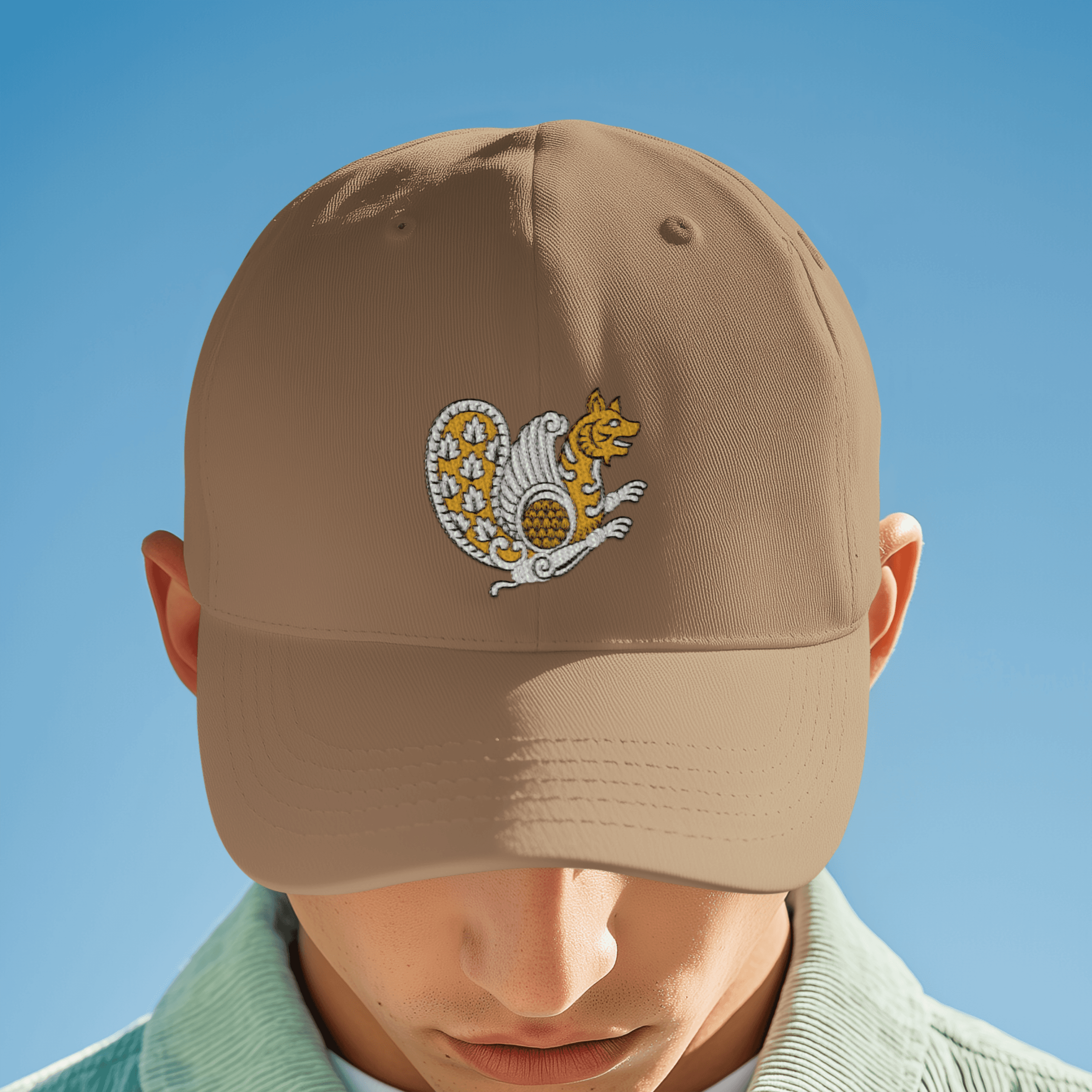
Six parts of the Sēnmurw as the Sasanians drew it. This is the creature from Khosrow II's robes — not, or not obviously, the bird that raised Zal. Where the two part company, we have said so.
What you seeA canine head in profile, snarling, ear pricked, teeth showing.
What is knownThis is the element that makes the creature a puzzle. Later Zoroastrian texts classify the Sēnmurw as a bat — teeth like a dog, a cave for a home, milk for its young — but scholarship reads that as an explanation invented after the fact, to account for an image nobody could otherwise place.
What you seeFeathered wings, curling forward, rising from a circular base.
What is knownFeathers, not bat membrane. This is the detail that undercuts the bat theory, and it is why the identification is still argued over.
What you seeA disc at the root of the wing, filled with a lattice of small rosettes.
What is knownThe roundel is a signature of Sasanian textile design; the creature travelled across Eurasia on woven silk, which is much of why it turns up later in Georgia, Armenia, Byzantium and early Islamic Syria and Jordan.
What you seeA long raised tail curving up and over the body, worked in leaf forms rather than individual feathers.
What is knownIt is a peacock's tail — an Indian bird, not an Iranian one — and the peacock arrives with its own associations: splendour, and the coming of the rains.
What you seeForelegs thrown forward, one above the other.
What is knownThese are a predator's paws, and in the Sasanian examples they carry only three claws. The Pahlavi Bundahišn calls the Sēn “three-fingered” and the largest of all birds. Most birds have four.
What you seeA creature that reads as a hunter.
What is knownThe oldest texts describe something else entirely — a bird nesting on the all-healing tree in the middle of the sea, whose rising and settling scatters the seeds of every plant on earth, and whose arrival means rain. In the Avesta, fortune is wrapped around a house “like the great bird Saēna.”
The name comes from Avestan mərəγō saēnō, “the bird Saēna” — not from si murgh, “thirty birds.” That reading is Attar's pun, four hundred years after Ferdowsi, when thirty birds survive the journey to find their king and discover they are him. It is one of the finest endings in Persian literature. It is not where the word came from.