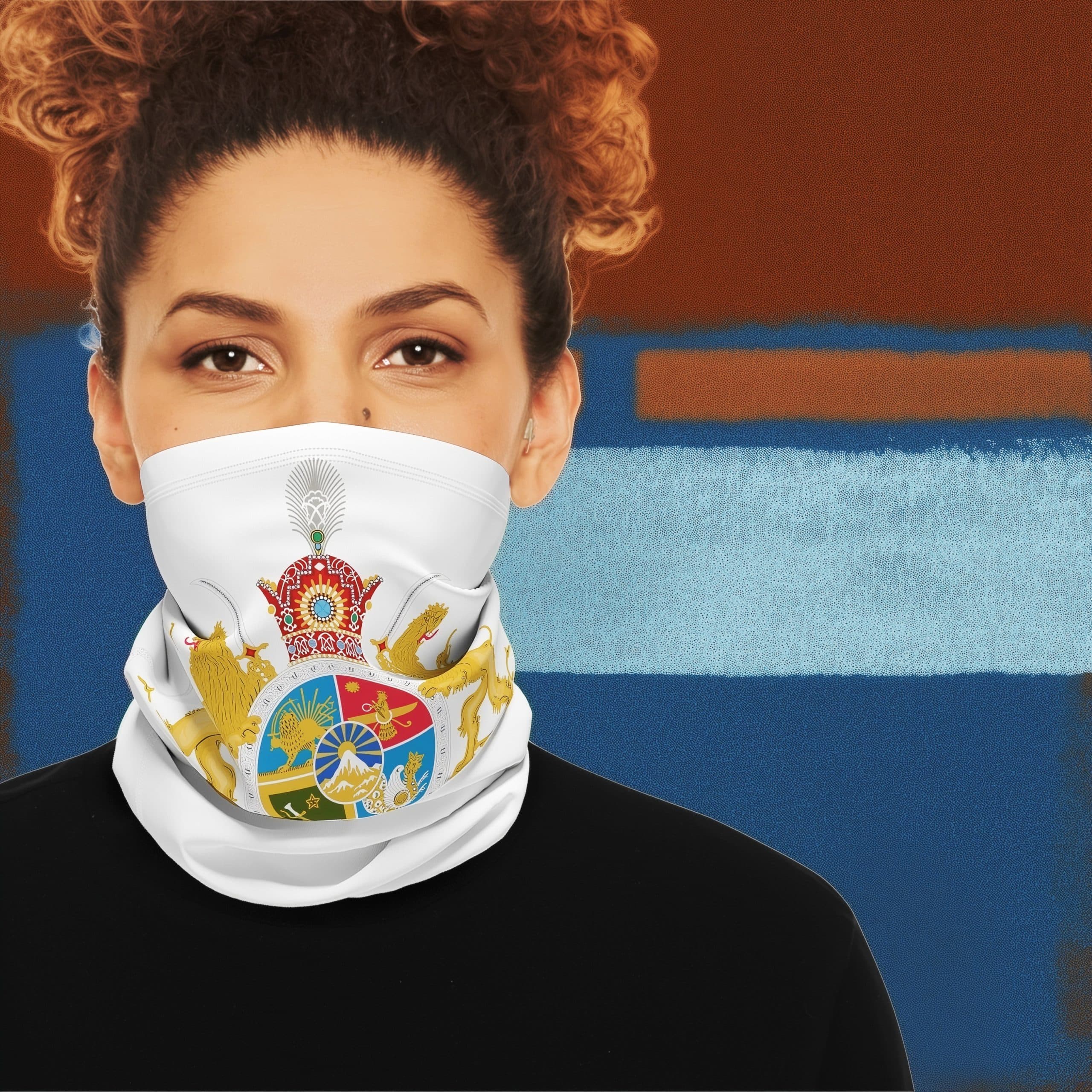
Four quarters that disagree with each other, put on one shield anyway.
Six parts of the Imperial Arms. Four of them are separate symbols in their own right, and three appear elsewhere in this collection. Read together, the shield is an argument about what Iran is.
What you seeTop left, on blue — a lion with a raised sword, the sun rising behind it.
What is knownThe oldest device on the shield and the one that reached the flag. It began as astrology — the sun in the house of Leo — and only became national much later. The upright, armed posture was ordered by decree in 1836.
What you seeTop right, on red — a winged figure rising from a disc.
What is knownThe pre-Islamic inheritance, carried at Behistun and Persepolis, and the most argued-over symbol in Iranian art. Its presence here is a claim about depth: the country did not begin with any of its dynasties.
What you seeBottom left, on green — the bifurcated sword, its blade splitting into two points.
What is knownThis is Ali's sword, and its presence makes the shield explicitly Shia. It sits one quarter away from a Zoroastrian symbol, and both were meant to be there.
What you seeBottom right, on blue — a winged creature.
What is knownThe mythological register. Its oldest layer is not heroic but agricultural — a bird nesting on the all-healing tree whose rising scatters the seeds of every plant, and whose coming means rain.
What you seeThe centre, a small shield of its own — a white peak with the sun rising behind it.
What is knownThe highest mountain in Iran, placed underneath all four quarters. Everything else on this shield is an idea. This one is a place.
What you seeAbove the shield, a crown with an aigrette.
What is knownThe Pahlavi Crown, made new for the coronation of Reza Shah in 1926. The design of an Iranian crown changes with the house that commissions it, which is why period emblems differ from one another and why the crown dates any example that carries it.
Four quarters: the national emblem, the Zoroastrian inheritance, Shia Islam, and the mythological tradition. A mountain at the centre holding them up, and two lions holding the whole thing off the ground. Whatever else it is, it is not a simple claim.